
Business travel often requires employees to spend their own money up front. Meals, flights, transportation, and hotels all add up pretty fast. So when reimbursements take too long, frustration builds. Delayed travel expense reimbursements not only affect employee satisfaction but also create accounting bottlenecks. The question here is, how long should it take, ideally?
While the ideal reimbursement window in most businesses is usually between 3 and 10 business days after an expense report is approved. The answer still varies depending on approval workflows and expense management systems.
Standard Timeline for Travel Expense Reimbursement
Although there’s no specific reimbursement rule that applies everywhere, companies usually follow a structured timeline that looks like this:
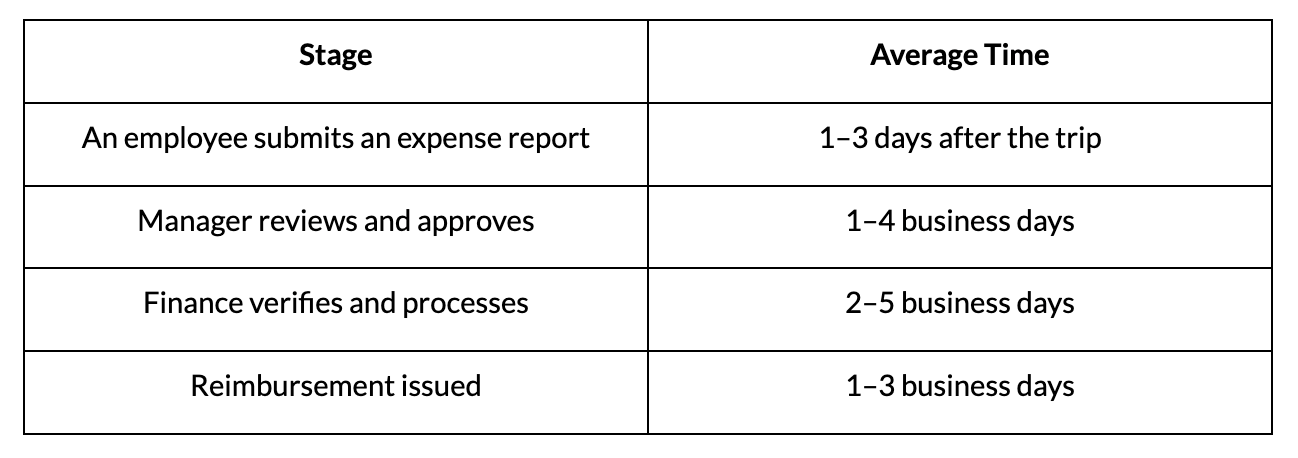 If the process is smooth, employees should receive reimbursement within a week or two of submission. For businesses using automated systems, the process is even faster than that. According to the Global Business Travel Association, delayed expense reporting and approvals are among the most common causes of slowdowns and expense visibility.
Why Reimbursements Often Take Too Long

Travel expense reimbursements take too long due to paper-based, manual processes, missing or improperly categorized receipts, and complicated workflows. In turn, these days are exacerbated by manual entry, which is time-consuming (averaging 20+ minutes per report) and error-prone, causing trouble in accounting departments. Here’s more about the common causes:
- Manual Expense Submission: When employees submit business expenses in email attachments or spreadsheets, managers spend extra time verifying and organizing data.
- Slow Approval Chains: Multi-level approvals can also create delays. Let’s say that if there’s a situation when one approver is unavailable or misses an email, the entire process stops.
- Missing Documentation: Unclear business purpose, incomplete receipts, or policy violations result in reports being sent back over and over for corrections. This causes additional back-and-forth.
- Batch Payment Cycles: Some businesses process reimbursements only weekly or bi-weekly. Even approval expenses may wait until the very next payment cycle.
Poor Policy Communication: In case employees are unfamiliar with submission deadlines or specific documentation requirements, reports are typically rejected or delayed.
How to Speed Up Travel Expense Reimbursements

Swift reimbursement processes are convenient, yes. But more than that, they are crucial for employee morale, financial health, and maintaining long-term trust.
Step 1: Encourage Employees to Submit Expenses on Time
While the responsibility lies with the accounting team to process employee expenses fast, it’s also important that employees fulfill their role. Because if employees are taking weeks and sometimes months to submit their mileage reports or expenses, it creates a blockage in the process. Motivate your workers to file their expenses as soon as possible by setting a deadline. More so, explain that it’s to help them stay responsible and finish tasks on time.
Step 2: Have a Clear Expense Policy in Place
Make the reimbursement method as simple as possible. Doing so will guarantee that they don’t face challenges that may delay report submission. The best way to do this is to have a simplified expense policy for out-of-pocket, mileage, and travel expenses. Within this travel policy, highlight comprehensive guidelines on:
- Eligible travel expenses for reimbursements (e.g., amount and category)
- Required expense details (including the merchant name, transaction date and description, and amount spent)
- The whole procedure for requesting reimbursement
- Results of late expense submissions (tax obligations or delayed reimbursement)
- Timeline for payment
Step 3: Use an Expense Management Software
The easiest way to increase employee expense reimbursement by 3X is by using an automated expense management platform. Not only does this allow digital expense report submission in real-time, but it also prevents delays. With features like automatic policy enforcement, real-time receipt scanning, and a track of activities, it saves a lot of time that manual data extraction would otherwise take. It also alerts employees to expense issues before submission (if any), which allows quick fixes and further enhances approval speeds.
Conclusion
To sum it up, it should take 3-10 days after approval to get travel expenses reimbursed. Anything longer points out unclear policies, manual processes, and inefficient workflows.
That’s why your company should incorporate real-time tracking, and automated approvals to guarantee a hassle-free experience at the workspace. This way you can considerably speed up the whole thing without sacrificing compliance. All you need to do is implementing this tool into your routine, and watch reimbursement procedures settle down without much effort.