


Managing company expenses without a clear-cut policy causes small leaks that turn into big financial gaps. Approvals become inconsistent, teams overspend, and financial visibility is lost.
A well-designed expense policy addresses all this by setting clear boundaries and defining acceptable spending. Plus, it has to reflect how your business actually operates, or else, employees will ignore it. This guide covers how to create an expense policy for your company, along with templates and foolproof practices teams can rely on.
What is an Expense Policy Important?
An expense policy serves as a control system that sets clear rules for how money can be spent on business-related expenses. It ensures the expenditures are tracked, controlled, and well-aligned with company budgets.
At its core, it answers the following questions:
- What can employees spend on?
- How much are they allowed to spend?
- What approvals are required before purchase?
- What documents are needed for reimbursements?
- What are the specific spending limits?
- Who is responsible for reviewing & approving expenses?
Where and when must digital expense reports be submitted?
Key Components Every Expense Policy Must Include
Rather than writing a long document, focus on clarity in areas where problems usually occur.
1- Expense Categories and Coverage
Define what qualifies as a reimbursable expense. This generally involves meals and entertainment, travel, remote work or office expenses, and client-focused costs. Each category must state what’s excluded and what’s included. For example, specifying whether premium upgrades are reimbursable removed confusion.
2- Spending Limits and Thresholds
When limits aren’t defined, policies become challenging to enforce. Therefore, set boundaries of transportation class, hotel price caps by city, daily meals, etc. Instead of fixed global limits, many organizations utilize tiered limits based on travel location or role.
3- Approval Workflows
Keep approval workflows as simple as possible. For low-value routine expenses, no pre-approval is needed. Similarly, corporate travel bookings require manager approval. For high-value things or other exceptions, senior or finance approval should be mandatory.
4- Documentation Requirements
According to the IRS study, proper documentation (especially documenting amount, place, time, and business purpose) is critical for expense deductions. That said, proof of payment and receipts are necessary for audit readiness. Your policy should clearly state when receipts are required, the acceptable formats, and the deadlines.
5- Reimbursement Timelines
Delays in reimbursement affect the overall employee experience. Set expectations like processing time and submission deadline (i.e., within 7 to 10 days of expense). That will keep both the finance team and employees accountable, and everything will happen as scheduled.
Creating A Practical Expense Policy | Template & Best Practices
The expense travel policy is more like a working framework. Here’s a usable template with what to include + how to define it properly, so it works in day-to-day operations.
1. Policy Purpose
Be specific about the policy intent and outcome to give more clarity and set the tone. For example:
“This policy ensures controlled employee spending, improves audit readiness, reduces reimbursement delays, and aligns all expenses with company financial objectives.”
2. Main Scope
Write who the policy applies to (exactly) and in what situations. Clarify it as:
- Full-time employees = fully covered
- Contactors = only pre-approved expenses reimbursed
- Leadership roles = flexible limits with reporting requirements
Also, mention whether it covers client-facing expenses, remote work, domestic vs. international travel, etc.
3. Expense Categories
Break down categories with inclusions and exclusions. Below is a visual breakdown for better understanding:
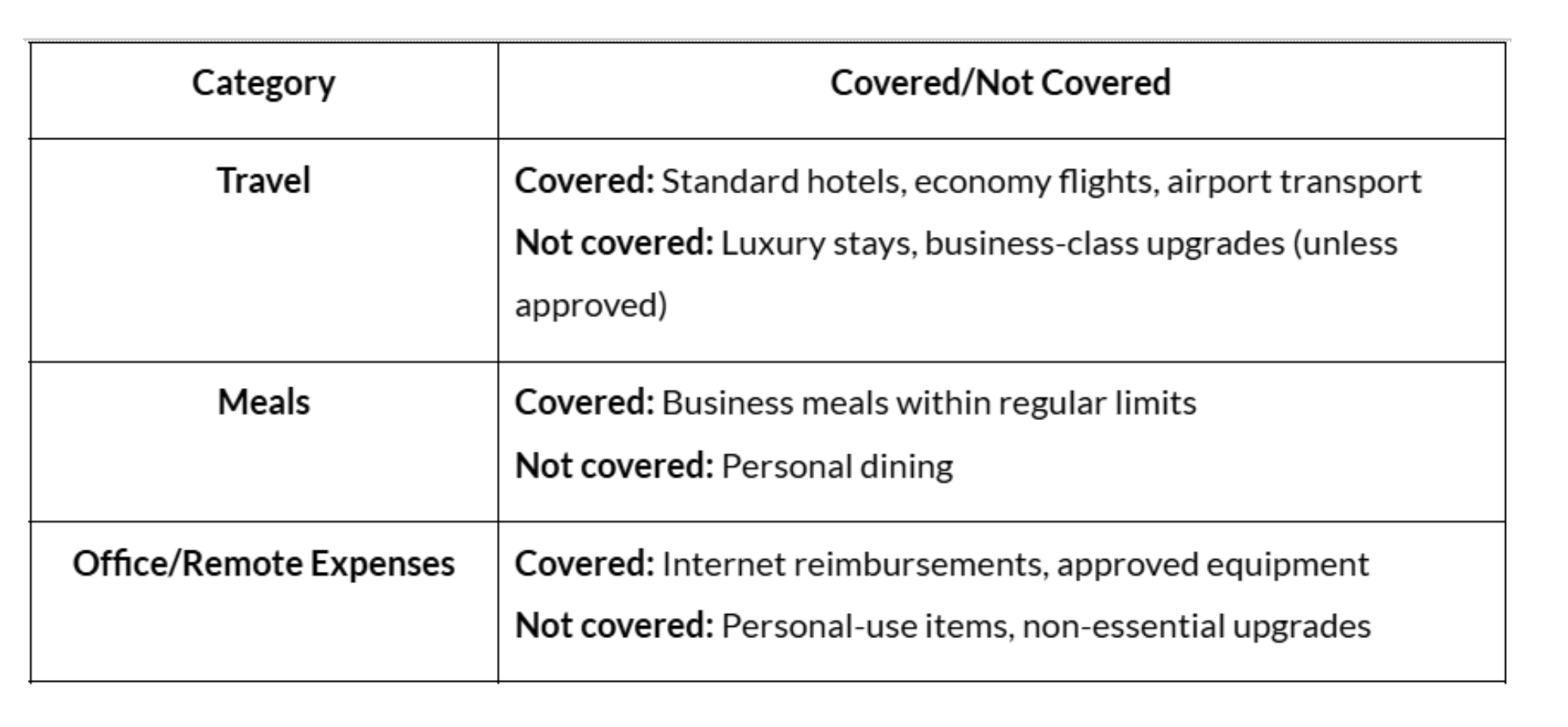
4. Spending Limits
One thing to note here is that fixed limits won’t work across locations or roles. And a better structure includes the category here, its standard limit, and even the exceptional rule. For instance, there is a “meals” category; a standard limit should be set, e.g., $25–$50/day, based on your company budget. It’s wise to add an exceptional rule to the case, i.e, a limit exceeded in expensive cities, with approval.
5. Approval Workflows
Approval delays add to operational inefficiencies. Make sure you elaborate flows depending on risk level and not hierarchy alone. Moreover, highlight escalation with care. If approval isn’t given within X hours, what happens? This all should be decided up front.
Note: Avoid multi-layer approvals for small expenses. Because they can slow down the tasks without improving control. So, apply stricter checks only when the risk is higher.
6. Reimbursement Process
An unclear timeline leads to unnecessary follow-ups, frustrating employees. Try to be more specific about that.
- Payment method (payroll, bank transfer, etc.)
- Approved expenses processed within X business days
- Cutoff cycles (bi-weekly or weekly)
When employees trust that reimbursements are predictable and fast, they are more likely to follow submission rules properly.
7. Policy Violations
Focus on accountability wen definition policy violation. When creating the policy, state what constitutes a violation and what happens next. This improves the system, keeping enforcement consistent without creating any hindrance later on.

Conclusion
An effective expense policy doesn’t try to control every possible situation. Instead, it focuses on the areas where financial risk and confusion are most likely to occur. When you define clear categories, simplify approvals, enforce limits, and integrate everything into a system, compliance becomes natural rather than forced. Automated tools enable organizations to apply all these principles by embedding policy rules directly into expense workflows. That means every submission is validated automatically, approvals follow a structured path, and accounting teams get real-time visibility into spending.